
Lending math
Loan Processing Fees in Kenya: Included or Upfront
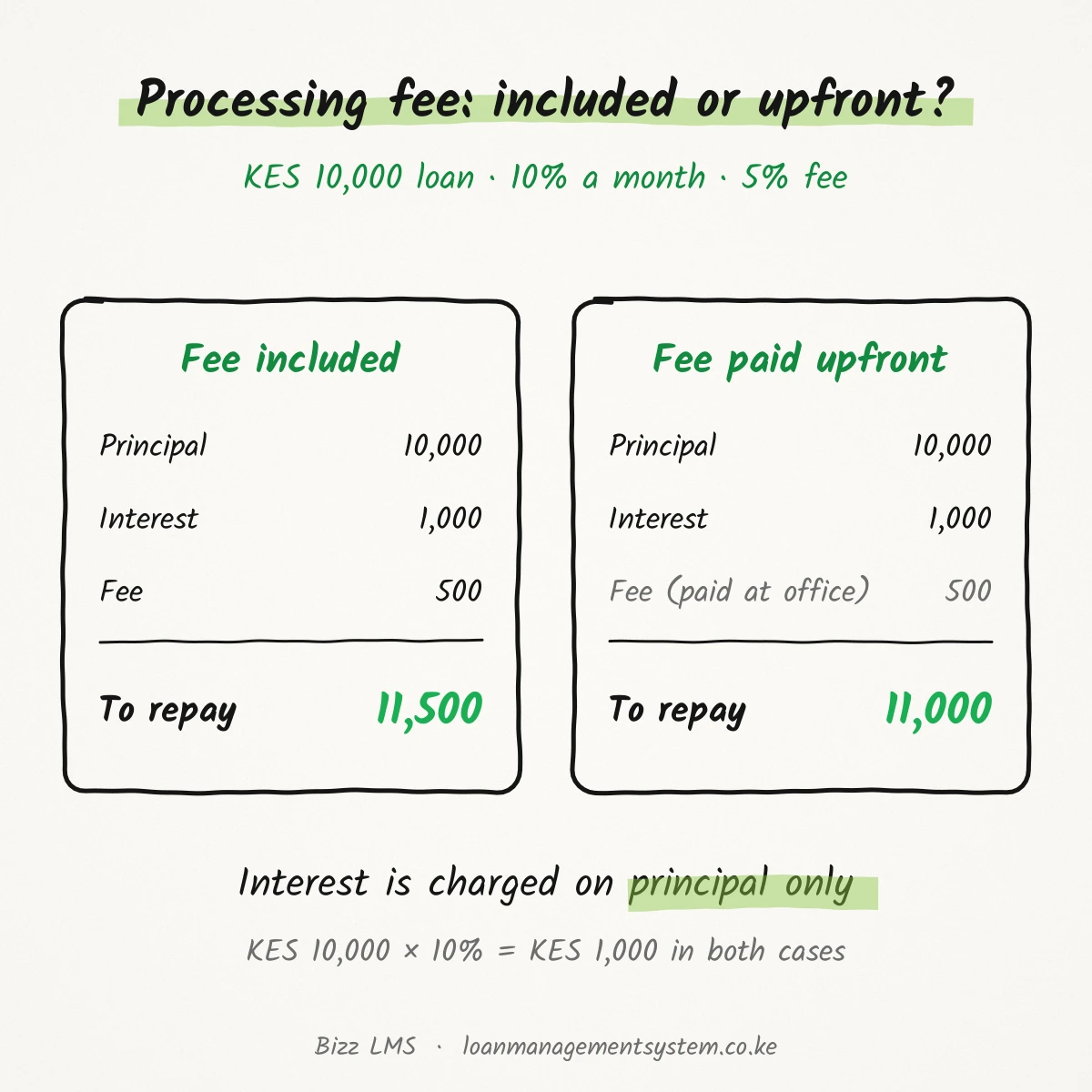
A loan processing fee in Kenya is either inside the amount the borrower repays, or it is paid at the desk before the schedule starts. Those are different contracts. They produce different balances after the same cash payment. Bizz LMS supports both, and it does not quietly switch between them. Interest is always on the principal only. This note publishes the worked example the product already uses, so an office can check a screen against a piece of paper.
The example is a loan of KES 10,000. Monthly interest is 10%. The processing fee is 5%. The borrower has paid KES 3,000. Penalty is not in the example. Figures are Kenya shillings.
The formulas, before the table
Interest = principal × monthly rate ÷ 100. On KES 10,000 at 10%, interest is KES 1,000.00. It is not calculated on the fee.
Processing fee = principal × fee rate ÷ 100. At 5%, the fee is KES 500.00.
If the fee is included in the loan, total to repay = 10,000 + 1,000 + 500 = 11,500.00. The instalments are shares of 11,500. The fee is on the schedule, so later payments can pay a portion of it.
If the fee is paid upfront, the KES 500 is shown and is not on the schedule. Total to repay = 10,000 + 1,000 = 11,000.00. Interest is still the full KES 1,000, because the principal did not shrink. The upfront fee is not a reduction of principal.
The worked table
| Line | Fee included in the loan | Fee paid upfront |
|---|---|---|
| Principal | 10,000.00 | 10,000.00 |
| Interest | 1,000.00 | 1,000.00 |
| Processing fee | 500.00 | 500.00 (shown, not on the loan) |
| Total to repay | 11,500.00 | 11,000.00 |
| Paid | 3,000.00 | 3,000.00 |
| Principal paid | 2,608.70 | 2,727.27 |
| Interest paid | 260.87 | 272.73 |
| Fee paid (on schedule) | 130.43 | 0.00 |
| Balance | 8,500.00 | 8,000.00 |
Read the paid lines across. When the fee is inside the 11,500, the KES 3,000 is shared in the same proportions as principal, interest, and fee: 2,608.70 + 260.87 + 130.43 = 3,000.00. The balance is 11,500 − 3,000 = 8,500.
When the fee was paid upfront, the schedule’s 11,000 is only principal and interest. The same KES 3,000 splits into 2,727.27 principal and 272.73 interest. Fee paid on the schedule is 0.00 because the fee was never an instalment. The balance is 11,000 − 3,000 = 8,000. The KES 500 upfront is a separate fact the statement shows. It is not still “owed” on the schedule.
Officers should say which column they are quoting. “The balance is 8,500” and “the balance is 8,000” can both be correct for the same principal, the same rate, and the same cash, if the products differ. The argument in the branch is usually that nobody said which product was used.
How instalments use the total
The full amount to repay is split evenly on real due dates. Daily, weekly, or every 30 days. The last instalment takes leftover cents. That rule applies to 11,500 or to 11,000. It does not apply to an upfront fee, because that fee is not in the total being split. The note on daily, weekly, and monthly instalments walks through the dates. Use both notes together when you are setting a product, not after fifty loans have been booked.
A payment the officer types — cash, M-PESA, cheque, or bank deposit — keeps the date they enter. Coverage shows which instalments the money touched. Paybill money that matches the national ID, or that staff allocate from the unallocated list, uses the same split. You do not get one mathematics for the counter and another for the till.
What month-end does with the fee
Income is not “everything that was paid”. Principal repaid is not income. Interest is income. The processing fee is income, whether it arrived inside instalments over time or as an upfront amount the statement showed at the start. Admins need the report that separates the three, on screen, PDF, and CSV, for one officer or one branch or the comparison. If the fee method is mixed inside one product by habit rather than by setting, the report cannot rescue the story. The companion article is principal, interest, and fee income reports.
Portfolio health does not replace that report. It answers a collections question: of the instalments and penalty charges due in the period, what portion was actually applied to those rows. A fee paid upfront at disbursement is not an instalment due this week. Do not expect the health percentage to narrate fee income.
What the office should decide in writing
Pick the method per product and name the product so officers can say it aloud. “Salary advance, fee upfront” and “asset loan, fee in the loan” can live side by side. Write the sentence on the paper the borrower signs, in the same words the screen will use. Included means the borrower repays the fee over the schedule. Upfront means the office collected the fee at booking and the schedule is principal plus interest only.
Do not describe either method as cheaper in this article. A lower schedule balance is not a gift if the fee was already paid in cash at the desk. A higher schedule is not a penalty. It is the fee travelling with the instalments. The right choice is the office’s pricing rule. Bizz LMS records the rule. It does not publish a recommended percent.
There is no card checkout inside the LMS to collect the upfront fee, and there is no STK Push. Upfront means the office took the money by the methods staff can already post: cash, M-PESA, cheque, or bank deposit. Record it. The statement shows it. It stays off the instalment rows.
Check it on a demo, not on a slogan
Ask to see both columns with the same KES 10,000, the same 10%, the same 5%, and the same KES 3,000. If the balances are not 8,500 and 8,000, you are not looking at this arithmetic. Book a demo and bring a calculator. The feature list states the same formulas in short form. The best loan management system in Kenya uses the short balance comparison. If you are still choosing a system, put this table next to the Paybill test in how to judge a loan system in Kenya. A product that cannot show both fee methods will force every loan into one story, and the branch will keep the other story in an exercise book.
Questions from this note
Is interest charged on the processing fee?
No. Interest is principal times the monthly rate, on the principal only. The fee is principal times the fee rate. The fee is not inside the interest calculation.
Which column is “the” balance?
It depends on the product setting. Fee included in the loan produces a higher total to repay. Fee paid upfront is shown but is not on the schedule, so the repayable total is lower.
Do these figures include penalty?
No. The worked example is principal, interest, and fee only. Unpaid penalty is added into balances in the live system when penalty rows exist.
Can the office use both methods?
Yes. Each loan product can include the fee or treat it as paid upfront. Say which one a product uses before officers start booking loans on it.