
Penalties
Loan Penalty Policy for Kenyan Offices
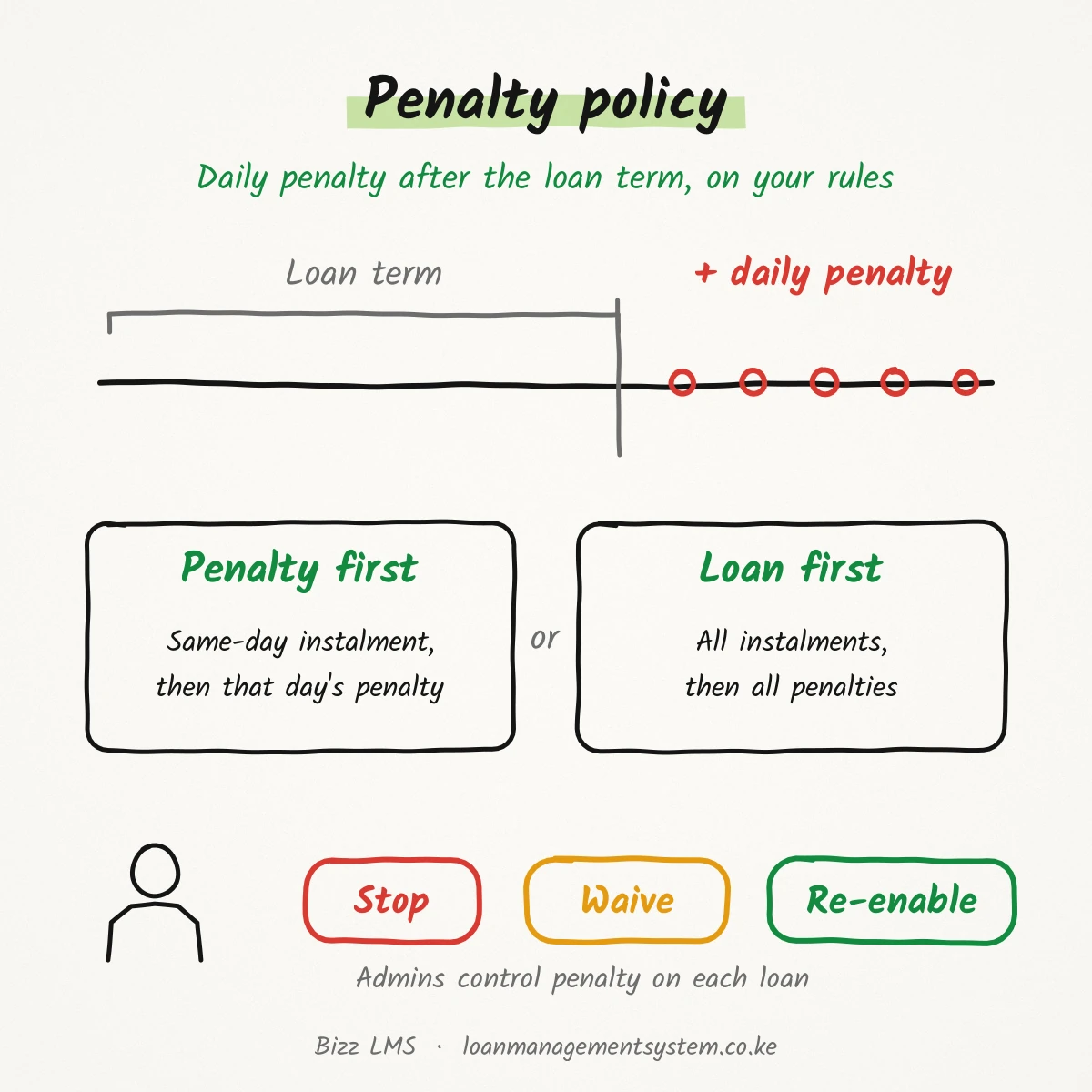
A loan penalty policy in Kenya should be a sentence the officer can repeat, not a surprise on the statement. Bizz LMS lets the office turn penalties on or off. When they are on, daily charges can accrue after the term, and grace options can delay the first one. Each charge is a row with a total, an amount paid, and an amount unpaid. This note explains the order of deduction and what “the loan is finished” is allowed to mean. It does not set your rate. If a vendor demo assumes a percent, ask them to show the switch that turns the whole thing off.
When a charge is allowed to start
The schedule of instalments is the contract the product built: principal, interest, and any processing fee that was included in the loan. Penalty is not that schedule. It starts after the term, if the office has penalties enabled. Grace is the waiting period the office configures so a due date that lands on a day the branch was shut does not become a charge at midnight. Use grace on purpose. Do not use “we will ignore it in the book” as a substitute, because the next officer will not ignore it.
New daily charges stop once the instalments themselves are fully paid. You do not keep minting penalty on a loan whose schedule is clear. The loan still stays open until the penalty that already exists is paid. That distinction is the one borrowers dispute, so say it at disbursement: finishing the instalments stops new charges; it does not erase charges already raised.
Unpaid penalty is included in balances and in arrears everywhere the system shows a total. A collections screen that hid penalty would make the SMS lie. The queues — Needs work, Today, Broken promises, No promise, Upcoming, and All — include it. The reminder can quote a balance that contains penalty. Preview the SMS so you see that number before it goes out. Collections practice is in SMS reminders and queues.
Penalty first and loan first
The office picks a deduction order. The names are easy to misunderstand, so use the operational meaning.
Penalty first means: take the same-day instalment, then that day’s penalty. It is not “all penalties in the book before any instalment”. It is the same day, instalment then penalty, as the setting describes.
Loan first means: all instalments, then all penalties. Money keeps clearing the schedule until the schedule is done, and only then penalty rows.
Write the chosen order next to the product rules. A payment at the counter and a Paybill receipt that matches the national ID both follow it. So does an allocation of an unallocated receipt. Staff should not keep a second notebook that says “we actually do it the other way”. If the branch wants the other way, an admin changes the setting. The audit trail is there when someone asks who changed it.
Admins can stop penalty on a single loan, waive it, or turn it back on. Stop is for a case you are freezing. Waive is for an amount you are removing. Re-enable is for when the freeze is over. Officers who are not admins can read the rows on their own borrowers. They should not be the person who waives, unless you have granted them admin and accepted that they can also touch settings.
What a payment looks like when both exist
Picture a day when an instalment is due and a penalty charge exists for that day. You receive less than the two rows combined. Under penalty first, the same-day instalment is dealt with, then that day’s penalty takes what remains. Under loan first, instalments across the loan come first, and penalty waits. Do not publish this paragraph as a shilling example with a made-up penalty percent. Your charge is yours. The order is the part the software fixes so two officers do not invent two orders.
The statement prints instalments and penalty rows together, and it can be saved as PDF. A borrower who wants “the paper” should be given that statement, not a total reconstructed in WhatsApp. If the rows do not match the spoken policy, fix the setting or the waive. Do not fix it by editing the PDF in another tool.
Balance math for the original loan, without penalty, is in the fee example. Add penalty on top of that understanding: unpaid penalty joins the balance the screens show. The fee example’s 8,500 or 8,000 is not a promise once penalty rows exist. Say so when you quote it.
Grace, stop, and the audit
Grace options exist so the first charge is not automatic on the morning after the term if the office has a reason to wait. Decide the number of days with the people who face the borrowers, then leave it. Changing grace every Friday makes the statement look arbitrary, which is how penalty policies die.
Stop and waive need a reason in the comment habits of the office. The loan already has an approval comment thread for the decision to lend. Penalty waives are admin actions. The audit trail records payments, allocations, loans, and settings. Use it. A waive with no memory is how a branch accumulates silent discounts.
Rejected loans never grow a schedule, so they do not grow penalty either. Pending loans are not an open approved facility for Paybill to settle. Do not expect a penalty on a file that was never approved.
What this policy will not cover
It will not file a CRB listing. It will not message a guarantor through a borrower app, because there is no borrower app. Guarantor name, phone, and ID sit on the file so a person can call them. The system will not debit a savings account to clear penalty, because it does not hold savings. If your policy says “we recover penalty from shares”, you are in SACCO territory and this module will not post that entry.
It will also not choose a rate that keeps you inside a statute. That is your compliance work, not a field default. We do not claim a regulator has blessed a percent. Configure what you can defend.
See it before you argue about it
On a demo, ask for penalties switched off, then on, then a waive, and read the balance each time. The short page is penalty tracking. Schedules underneath the penalty are daily, weekly, and monthly instalments. The staff workspace as a whole is features, and the public summary is the best loan management system in Kenya. If the open question is still which product category you need, use the criteria for a Kenyan loan system before you spend the call on rates.
Questions from this note
Does Bizz LMS publish a default penalty percent?
No. The office turns penalties on or off and sets the charge it intends to use. This article does not invent a rate.
What does penalty first mean?
Penalty first applies the same-day instalment, then that day’s penalty. Loan first applies all instalments, then all penalties.
Does the loan close when instalments are finished but penalty remains?
No. New daily charges stop once instalments are fully paid, but the loan stays open until the penalty is paid.
Can an officer waive a penalty?
Admins can stop, waive, or re-enable penalty on a loan. Officers see the rows on their borrowers. They post admin actions only if they have been granted admin.