
Collections
Microfinance Collections & SMS Reminders in Kenya
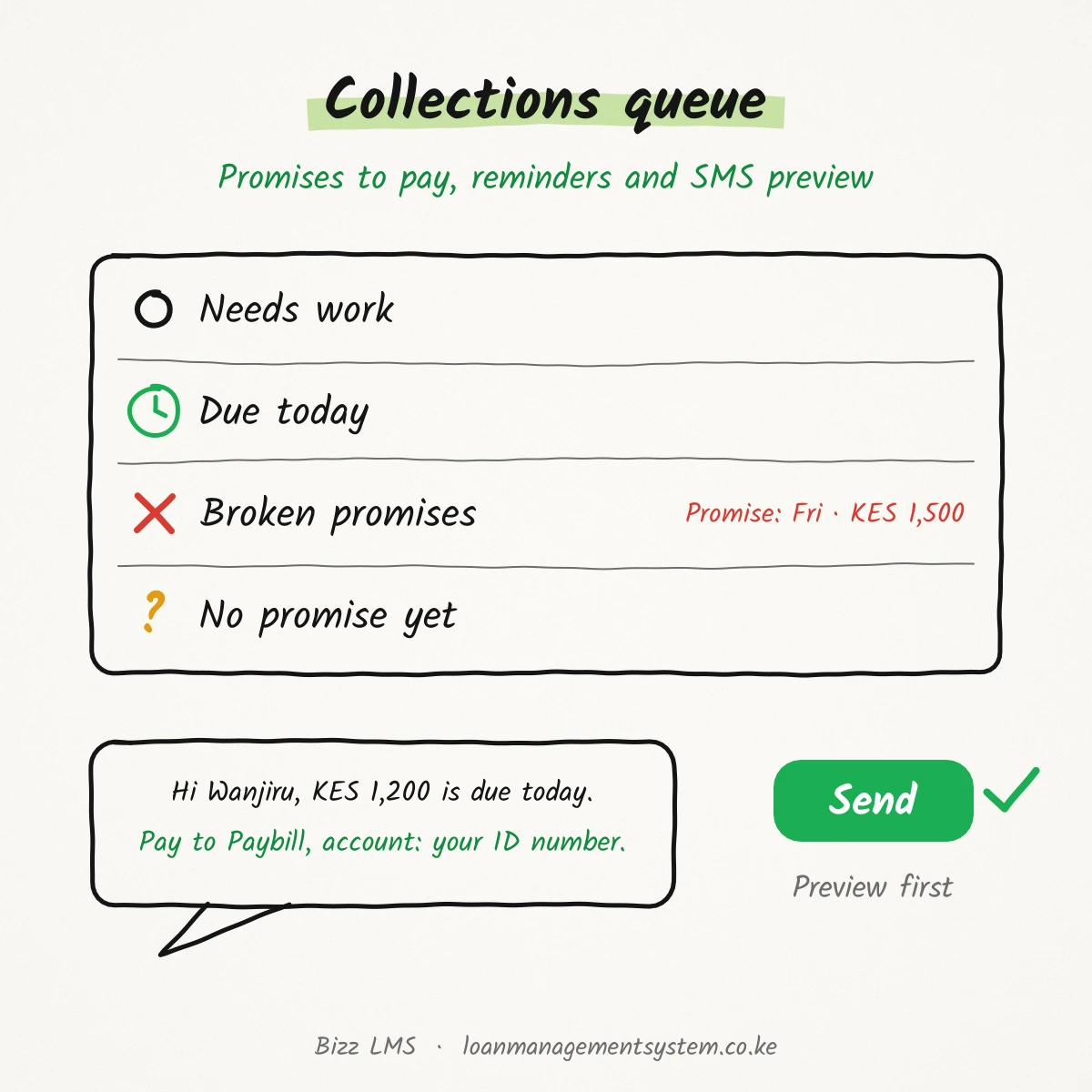
Microfinance collections in Kenya are a list of people, not a percentage on a slide. Someone was due yesterday. Someone promised to pay on Thursday from a Paybill. Someone has never been given a follow-up date. SMS is useful after that list exists, and it is careless before it exists. Bizz LMS puts overdue instalments and unpaid penalty into queues, stores a promise to pay, and previews a bulk reminder before anything is sent.
The providers are Ujumbe and Tilil. You bring the sender ID. The system does not invent one, and this article does not name a shortcode for payments. Payment instructions inside the SMS should point the borrower at your Paybill and their national ID as the account.
The six queues
Needs work is the overdue set that still needs a human act: a call, a note, or a new promise. Today is the follow-ups dated today, including promises that mature this morning. Broken promises are dates and amounts that passed without the payment. No promise is arrears that nobody has dated yet. Upcoming is what is still ahead. All is the full list, overdue instalments plus unpaid penalty, when you need to stop filtering and just see the book.
An officer records a promise with a follow-up date and an amount. The promise is not a payment. The balance does not move until cash, M-PESA, a cheque, or a bank deposit is posted, or until a Paybill receipt matches or is allocated. If Thursday passes with no money, the row is no longer a hopeful note. It belongs with the broken promises, where the next conversation starts from the missed date instead of from zero.
Officers see this for their own borrowers. They do not browse a colleague’s book unless they have been granted admin. That keeps a branch honest when two officers collect and the incentive is to look busy on someone else’s names. Admins see across officers and still have the separate income reports when the question is earnings rather than who to call. Those reports are described in principal, interest, and fee at month-end.
What the preview is for
Bulk reminder SMS runs through a preview wizard. The office sees who will receive which text, then sends. The point is the balance token. A template that says the wrong amount, sent to the whole arrears list, creates a morning of arguments you cannot unsend. Preview is the pause.
Templates live in Settings. The tokens are {name}, {amount}, {balance}, {phone}, {reference}, and {id}. Write the Paybill sentence with {id} so the account number in the text is the national ID on the file, not a number someone typed from memory into a shared phone. The sender ID comes from Settings. Messages to Kenyan numbers go out as 254…. If your file still has a leading zero, the send path uses the 254 form. Do not build a second list of numbers in a spreadsheet beside the system.
A payment acknowledgement is a different message. It goes after an office payment and after an M-PESA confirmation. It is not the arrears reminder. The borrower activity tab stores the reminder log next to the notes, so the officer who picks up the file on Friday can see that a text already went on Wednesday. Notes are for the promise and the excuse. The log is for the fact of the send.
How penalty and Paybill change the list
Unpaid penalty is part of arrears. A loan can show a cleared instalment and still sit in the queue because the penalty row is open. Daily charges stop once instalments are fully paid, but the loan stays open until the penalty is paid. If your queue looks “stuck” after the schedule dates are clear, read the penalty rows before you send another reminder that only talks about the instalment. The policy note is loan penalties for Kenyan offices.
Paybill changes who should be in the queue at all. A receipt that used the wrong account sits as unallocated. The loan still looks overdue. Texting that borrower “you have not paid” is how you train them to ignore you. Clear the unallocated filter first. Then preview. The match rule is the national ID, and the longer reconciliation note is Paybill loan reconciliation. Portfolio health will not count that unmatched cash as collected against the due rows. The dashboard can still show cash in the period. Use the queue, not the health percentage, to decide who to call.
A workable week
Monday: unallocated receipts, then Needs work, then Broken promises. Record promises with a date and an amount, not “next week” in a notebook. Mid-week: Today, and only then a preview of reminders for the people who had no contact. Do not send All because it is the biggest button. Upcoming is for planning a field day, not for threatening people who are not yet due.
Keep the template short. Name, amount or balance, Paybill, ID as the account, and the sender they already know. A novel does not survive a feature phone. Do not promise a receipt in the SMS that the system will not post. Acknowledgement comes after the money is on the loan, not before.
There is no borrower app to ping, no USSD session to open, and no STK prompt to fire. If your collections design assumes the borrower’s phone will wake with a pay button from this system, it will not. The phone wakes because an SMS arrived, or because the officer called. That is the product you are reading about.
Write the promise in the system the same day you make it. A date that lives only in a notebook will not appear under Today the next morning, and the officer who is off will not see it. If the borrower names an amount, store that amount. A promise without an amount is a mood, and Broken promises cannot tell a small miss from a large one. The follow-up date is a Nairobi date.
Where this sits in the system
The screen is described on collections, arrears, and SMS. The rest of the staff workspace is on features. The checklist that puts collections next to Paybill, schedules, and reports is the best loan management system in Kenya, defined as a test. To see the preview on a sample book without texting your clients, book a demo. You can also start from the best loan management system in Kenya. Tell us the rough number of active loans and whether the sender ID is already registered. We reply within 24 hours on business days.
Questions from this note
Can officers text the whole branch?
Officers work the arrears on their own borrowers. Bulk SMS still goes through a preview of who will receive what. Admins see the wider book.
Which SMS companies are supported?
Ujumbe and Tilil. The sender ID is taken from Settings. Kenyan numbers are sent as 254….
Does a promise clear the arrears?
No. A promise stores a follow-up date and an amount. The instalment is still unpaid until a payment is applied. A missed promise can sit in Broken promises.
Is there a borrower app for reminders?
No. Reminders are SMS to the phone on the file. There is no borrower app, USSD menu, or STK Push in this product.