M-PESA
M-PESA Paybill Loan Reconciliation in Kenya
Paybill loan reconciliation in Kenya fails in a boring way. The money is in the till statement. The loan still shows arrears. The officer then argues with a borrower who has an M-PESA message on their phone and a balance on your screen. The fix is not a louder SMS. The fix is an account reference the system can match, and a queue for the receipts that miss.
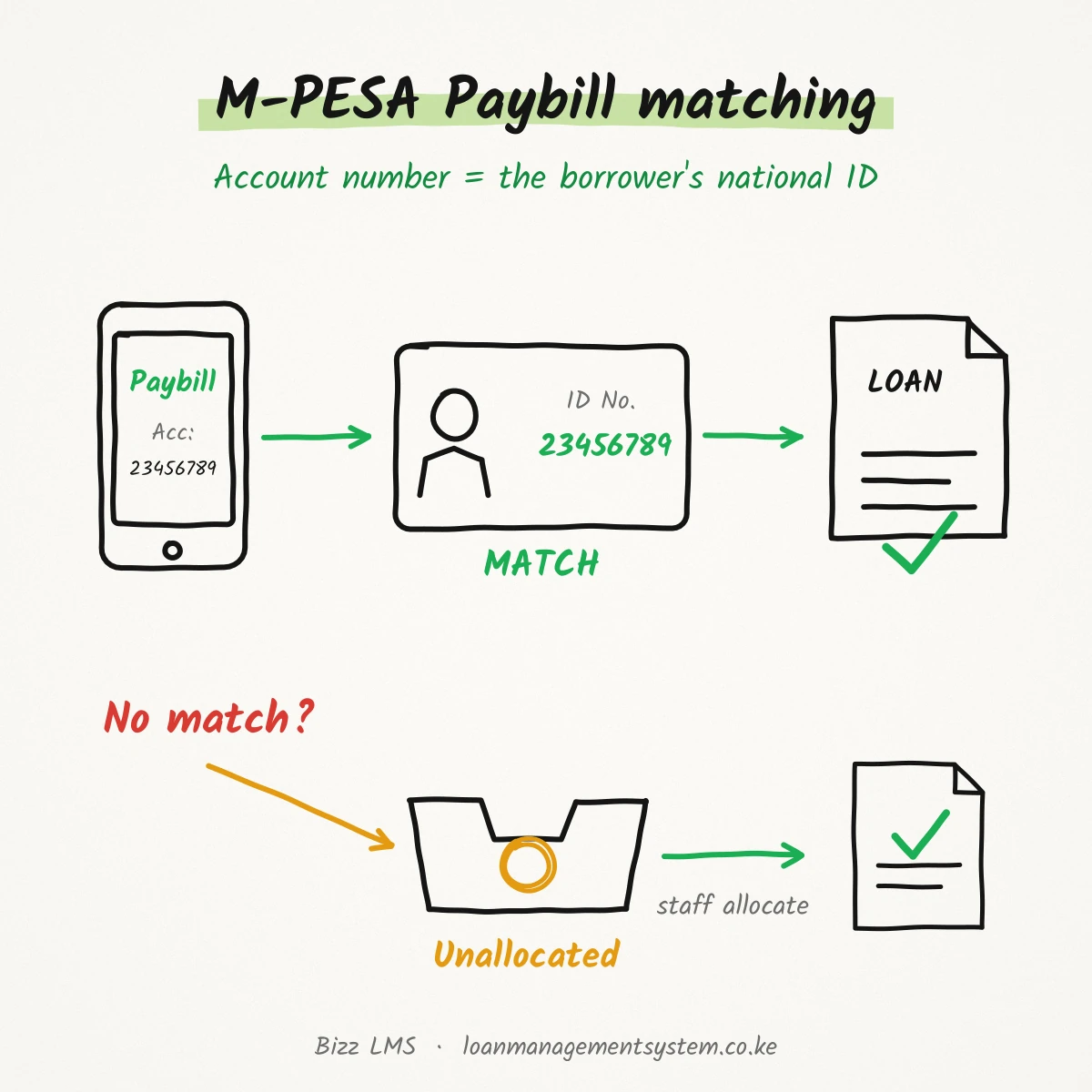
Bizz LMS matches the Paybill account to the borrower’s national ID. If that person has an open approved loan, the payment is applied like a payment typed at the desk. If the ID is unknown, or there is no open loan, the receipt is unallocated until a member of staff allocates it. This note is the operating picture. It is not a Safaricom manual, and it does not print a shortcode.
What Paybill sends, and what the loan file still needs
A confirmation carries an amount, a time, a sending phone, and an account string the payer typed. None of that, by itself, tells you which instalment was cleared or whether a penalty row was touched. The loan system has to make that decision with the office’s rules. Staff also need the payment date that belongs to the receipt, not a silent rewrite to “today” when someone posts it in the morning.
In Bizz LMS, a staff payment keeps the date the officer enters. Paybill money, once matched or allocated, uses the same coverage view: which instalments and which penalty charges the money paid. Delete reverses the payment off the loan. The list exports to CSV when the accountant wants the rows outside the screen.
Why the national ID beats the phone
A borrower pays from a spouse’s line after their own phone is lost. Another pays from a shop till because they were standing there. A third changed SIMs and the old number is now someone else’s. If your match key is the phone, all three become exceptions, and exceptions become a spreadsheet.
The national ID is already on the file, next to the phone, the town, the branch, and the officer. Guarantors are stored with an ID number as well, but the Paybill match uses the borrower’s ID. Search on the borrower list is by phone or by that ID, so the officer who takes a walk-in can find the file the same way the Paybill callback will.
The reminder template should say this in plain language: pay the office Paybill, and put your ID number as the account. Tokens available in Settings are name, amount, balance, phone, reference, and ID. Use the ID token in the sentence that tells them what to type. Providers are Ujumbe and Tilil. The sender ID is whatever you set. Numbers are sent as 254….
The path when the match works
The borrower is found. They have an open approved loan. The amount is applied in the office’s order. Instalments are paid according to the schedule. Penalty charges are rows of their own. The setting is either penalty first — the same-day instalment, then that day’s penalty — or loan first — all instalments, then all penalties. Interest and the on-schedule fee split out of the payment in proportion to how the loan was built. The balance that remains includes unpaid penalty.
A payment acknowledgement SMS can follow the M-PESA confirmation, and another follows a payment posted in the office. The borrower activity tab keeps the reminder log beside the notes, so the next officer can see that a text already went out.
The path when the match fails
No borrower for that account string, or a borrower whose loans are not an open approved facility, and the receipt waits. Staff filter payments to unallocated. Allocation onto a chosen loan uses the same principal, interest, and fee split as a normal payment. This is the morning job. Treat the unallocated list before you treat the arrears list as complete. A person can look overdue because their money is sitting in the unmatched pile.
There is a second trap. Excess money, after instalments and penalties, is stored as borrower credit. If a later unallocated receipt is the same money you had already parked as credit, allocation reverses that credit first. The loan is not paid twice. Adding a new loan does not auto-apply credit. Someone has to decide. That is deliberate. Silent application is how group books and digital books both lose an argument.
Mistakes that show up every week
People type the phone number as the account because every other Paybill in their life works that way. People type a first name, a till nickname, or an old ID from a previous registration. People pay after the loan is already closed and assume the system will open a new one. People pay the right ID on the wrong shortcode, which is a different till entirely. None of these are fixed by hiding the receipt. They are fixed by a queue a human can clear, and by a script in the SMS that repeats the ID rule.
Do not publish your shortcode on a marketing page that is not yours, and do not expect this website to list one. The live book bizz.ke has deployed uses that client’s own Paybill. Yours will be yours. During a demo we use an example, not your production till.
There is no STK Push in this product. If your process depends on a prompt that wakes the borrower’s phone, Bizz LMS will not send it. The borrower pays in. You reconcile. There is also no B2C disbursement from the app. Money out is your existing process. Money in is the part this system records.
What “collected” is allowed to mean
Portfolio health is collected divided by expected for the instalments and penalty charges due in the period you selected, using amounts actually applied to those rows. Unallocated payments do not inflate the score. The rate stops at 100%. The dashboard can still show all cash received in the period, which is a wider bucket. If those two numbers match every day, you are probably not looking at both. Admins who need the income split — principal against interest against fee — should use the reports, which stay the same on screen, PDF, and CSV. That subject is principal, interest, and fee income.
Officers only see their own borrowers, so an unallocated receipt still needs an admin or the owning officer to place it on the right loan. The audit trail records the allocation. That is the answer when someone asks who moved yesterday’s receipt.
Where to go from here
The product page for this behaviour is M-PESA Paybill matching on national ID. The rest of the workspace is on features. If you are still deciding whether a staff book is the right category, start with what “best” should mean for a Kenyan office and the best loan management system in Kenya. Bring your rough loan count and whether a Paybill already exists. We reply within 24 hours on business days from Juja.
Questions from this note
Should the Paybill account be the phone number?
No. Bizz LMS matches the account reference to the borrower’s national ID. The phone that sent the money is not the match key, because phones change and are shared.
What if the borrower has closed the loan?
A receipt with no open approved loan is stored as unallocated. Staff can allocate it later. It is not forced onto a closed loan.
Does this page list a Paybill number?
No. Each office uses its own shortcode. The rule to teach borrowers is “your Paybill, your national ID as the account”.
Can unmatched money inflate portfolio health?
No. Portfolio health uses amounts applied to instalments and penalties due in the period. Unallocated cash does not raise that rate, and the rate never exceeds 100%.